
ROOM 3. REFUSED AND UNREALISED WORKS: THE REASONS
“I am interested in the idea of a museum of the unrealised because, paradoxically, I think that ideas are already realised the moment we communicate them to others, on a conceptual level. Obviously, the rest ensures a certain degree of tangibility, but I see it as a subsequent step”
Davide Bertocchi
Continuing the account of the MoRE collection, one of the possible and most interesting approaches is to classify the reasons why the works themselves remained unrealised. The analysis of a more substantial corpus in a few years’ time will make it possible to draw conclusions that can only be introduced here, and which operate on two levels: that of commissioning and that of the reasons for non-realisation.
LOGISTICAL AND ECONOMIC REASONS
A first group of donated works comprises those that remained unrealised for logistical and economic reasons, that is, for technical reasons beyond the control or intentions of institutions and commissioners.
Among these works, for example, is one of Davide Mosconi’s projects, Triton (1976–77), an event and tribute to Beethoven which, conceived to last seven days, was intended to involve the entire city of Bonn. Beginning with the river, a barge carrying the orchestra would have navigated along it. The project was never realised because it was considered too demanding, both financially and organisationally.
Similarly, Paolo Scheggi’s project Cannocchiale Ottico, conceived by the artist for the 1968 Milan Triennale, devoted to the theme of the Grande Numero in the exhibition Interventi nel paesaggio, was not realised for economic reasons. More recently, the same occurred with Silvio Wolf’s project I nomi del tempo (2009), presented for the Italian Pavilion directed by Beatrice Buscaroli and Luca Beatrice as part of the 2009 Venice Biennale.
A borderline case, confronting the practical feasibility of a project situated between art and science, is Meteorite al contrario (2010) by Davide Bertocchi. The artist imagined launching a rock into space in order to overturn conventional rules and investigate the possibilities of interaction between human beings and space—quite literally, in reverse. The project has “not yet” been realised for purely economic reasons.
In the long term, this category of unrealised projects may provide us with information about the concept of technical and logistical, as well as material, limits: one of the fundamental issues in contemporary artistic practice today is precisely project development, knowledge of materials, and an awareness of actual technical and structural possibilities in relation to the conceptual dimension that dominated a long period of twentieth-century art.
POLITICAL AND IDEOLOGICAL REASONS
A delicate issue, closely related to censorship and addressed artistically through a highly influential digital project by Antoni Muntadas, The File Room (1993–present), the failure to realise a work for ideological or political reasons is documented in MoRE by a significant example: Mission Accomplished (2004) by Jeremy Deller. As the curator of the entry, Marco Scotti, writes, “the artist (…) invited to exhibit as part of Carnegie International in 2004, had presented this initial idea—which formed part of a more complex series of research and reflections on the contemporary war in Iraq—with the intention of producing one of his large banners on the façade of the museum, recalling the one used as a backdrop by President Bush during one of his speeches, bearing the words ‘Mission Accomplished’”, to which he added other reworked propaganda images.
It is interesting to note that this project was deliberately recounted and exhibited by the artist alongside others in the retrospective monographic exhibition Joy in People, and published in the accompanying catalogue in a section entitled “My Failures (2004–present)”. This indicates an explicit consideration of the project as an integral part of his practice, despite its unrealised status. In this respect, it can be compared with Muntadas’s frustration over the failure to realise a television project for Spanish television, which became a decisive impetus for the creation, in 1993, of an initial archive comprising approximately 400 censored projects. This archive subsequently gave rise to the aforementioned online project and to the exhibitions derived from and based on it.
THEORETICAL EXERCISE / UTOPIA
One reason why a work may remain unrealised is its intrinsic impossibility of being realised, which automatically places it within the category of utopia, or its exclusively theoretical nature. This category also includes works that were never actually submitted to a real commissioner, such as A Conceptual Noise (1999) by Ivo Bonacorsi.
One of the most significant projects collected and preserved by MoRE is Small Proposals Book (1990) by Jonathan Monk, produced when the British artist was still a student at the Glasgow School of Art. The book presents a series of proposals for projects that are, by their very nature, impossible to realise. In the year Glasgow was designated European City of Culture, Monk presented six projects and six fictitious letters of response from officials of the institutions to which the artist supposedly submitted his proposals, each accompanied by an image illustrating the idea. The responses reveal proposals to bring the pyramids to Glasgow Green, move the Golden Gate Bridge over the River Clyde, return the sense of driving to continental standards, transplant one of the giant redwoods from Redwood Forest, relocate Stonehenge in order to redevelop the fountain in Kelvingrove Park, and finally move Disneyland to the car park of the St. Enoch Centre for one year.
Other projects, when relocated within the historical and critical context to which they belong, constitute theoretical exercises and therefore have no genuine ambition to become realised works. This is the case with Nodi Urbani (1964–67) by Ugo La Pietra, which, as curator Francesca Zanella points out, can be traced back to “the theory of exploration and study of urban space developed within the design course between 1965 and 1967 with Blasi, Banfi, Seassaro and Stevan. (…) A common element in these drawings is the shaping and articulation of emergent elements within the densely built-up territory, difficult to decipher, which La Pietra’s dense network of marks attempts to translate.”
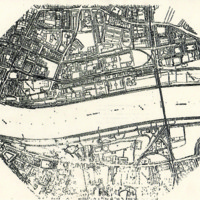
Davide Mosconi. TRITON (1976/77); LA LUCE DEL SUONO (1986).
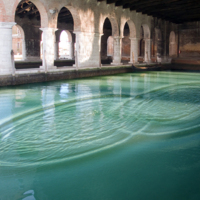
Silvio Wolf. I Nomi del tempo (2009).
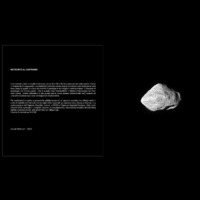
Davide Bertocchi. Meteorite al contrario (2010).
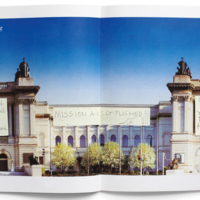
Jeremy Deller. Mission Accomplished (2004).

Ivo Bonacorsi. A Conceptual Noise... (1999).
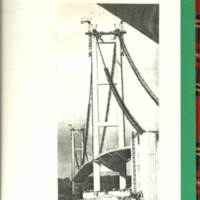
Jonathan Monk. Small Proposals Book (1990).
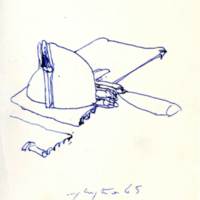
Ugo La Pietra. Nodi Urbani (1965-1968).
Davide Mosconi. TRITON (1976/77); LA LUCE DEL SUONO (1986).