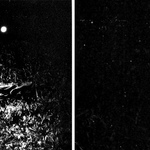
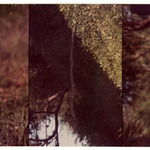
Franco Guerzoni was born in Modena in 1948. In the early 1970s, he began using photography as a means of representation. His Affreschi date from 1972, followed in 1973 by his Archeologie and subsequently by Antropologie, a body of research concerned with processes of cultural stratification and the idea of the “ancient” as loss.
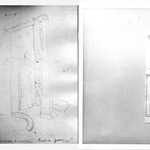
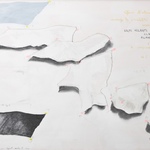
During the 1980s, he focused on the production of large wall maps exploring the idea of an imaginary geography, including Carte di viaggio, Grotteschi, and La parete dimenticata. Towards the end of the decade, he began investigating the surface understood as depth. In 1990, he presented Decorazioni e rovine in a solo presentation at the Venice Biennale.
From that point onwards, through a series of large-scale cycles of works, he continued his investigation into time and the poetics of the ruin, developing a kind of archaeology without restoration. In 2006, following the rediscovery of a body of photographic works produced by the artist in the 1970s, he presented Paesaggi in polvere at the GAM in Turin.
From that moment, his research was accompanied by a sustained practice of reconnection and transfer, moving from the painted image towards the physical wall itself. This pursuit follows the dream that links his earlier attempts to create a kind of bas-relief—an element that has remained constant throughout his work—to an idea of light sculpture born from his renewed attention to the wall.
Parete dimenticata thus becomes the privileged physical site of his most recent work.