
Per un museo del non realizzato. Pratiche digitali per la raccolta, valorizzazione e conservazione del progetto d’arte contemporanea
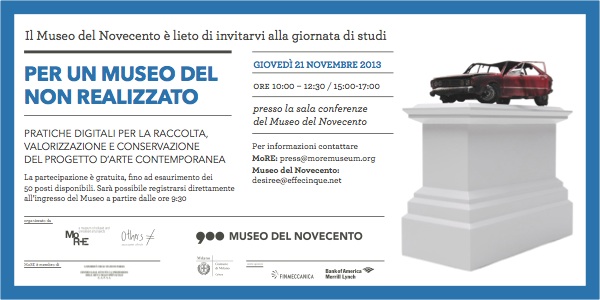
On Thursday, 21 November, the conference Per un museo del non realizzato. Pratiche digitali per la raccolta, valorizzazione e conservazione del progetto d’arte contemporanea was held. The conference was organised by the cultural association Others in collaboration with the Museo del Novecento in Milan.
Drawing on the experience of the digital museum MoRE. A Museum of Refused and Unrealised Art Projects, the conference opened a discussion on new exhibition practices, also in relation to the digitisation of archives and the promotion and preservation of unrealised artistic projects.
More specifically, the study day was divided into two sessions. The first, held from 10:00 a.m. to 12:30 p.m., was devoted to “Telling the Unrealised” and was moderated by Francesca Zanella (University of Parma). It opened with a presentation by Marina Pugliese, Director of the Polo del Novecento and Case Museo di Milano, entitled Una proposta per l’arte contemporanea: il museo dei progetti (A Proposal for Contemporary Art: The Museum of Projects).
The second presentation focused on Un museo per il non realizzato (A Museum for the Unrealised) and introduced the MoRE Museum project, conceived by Elisabetta Modena and Marco Scotti: a digital museum dedicated to preserving projects for contemporary artworks that were never realised.
This was followed by I would prefer not to – A taxonomy of artists without works, presented by curator and art critic Filipa Ramos.
The presentation by Roberto Pinto, curator and researcher in Contemporary Art History at the University of Bologna, entitled Quando la finzione diventa reale: Il museo dell'innocenza di Pamuk (When Fiction Becomes Real: Pamuk’s Museum of Innocence), explored the forms taken by a museum of real objects based on the imaginary story of characters created by Orhan Pamuk: a short circuit between fact and fiction, literature and art, project and realisation.
The first part of the day concluded with a dialogue between two artists, Luca Trevisani and Ugo La Pietra.
The former’s presentation, Vorrei ma non posso. L'esperienza del non realizzato nella pratica artistica contemporanea (I Would Like To, But I Cannot: The Experience of the Unrealised in Contemporary Artistic Practice), reflected on the different factors that, in an artist’s experience, lead to the realisation of a work or to its “failure”, as well as on issues surrounding commissions, sustainability, and the feasibility of projects considered “unrealizable”. Particular attention was devoted to works and projects related to editions and artists’ books.
Ugo La Pietra’s presentation, Nel e per il sociale: dall’effimero al non realizzato, un patrimonio artistico sommerso (In and for the Social: From the Ephemeral to the Unrealised, a Hidden Artistic Heritage), focused on the 1960s, when urban interventions were conceived through “models of understanding, projects, ephemeral installations”, characterised by a strong conceptual as well as spectacular component.
The second part of the day, held from 3:00 to 5:00 p.m., addressed the theme of “Digital Archives and New Ways of Exhibiting the Project” and was moderated by Danka Giacon, curator at the Museo del Novecento in Milan.
Stefania Zuliani, Professor of Museology and History and Theory of the Contemporary Museum at the University of Salerno, opened the afternoon session with a presentation entitled “Là dove le cose cominciano”. Archivi e musei del tempo presente (“Where Things Begin”: Archives and Museums of the Present), which compared archives and museums through their dual nature as places of preservation and production of memory.
Mario Gorni, President of Careof, Milan, addressed the theme Un lavoro infinito, dal nastro magnetico al file (An Endless Work, from Magnetic Tape to File), focusing on the transformations and adaptations constantly required by new technologies in order to preserve the visible traces of the culture of our time.
Gabriella De Marco, Professor of Contemporary Art History at the University of Palermo, presented the results of the research project Agave. Contributo allo studio delle fonti dell’arte contemporanea in Italia – e non solo – nel Novecento(Agave: A Contribution to the Study of Sources on Contemporary Art in Italy – and Beyond – in the Twentieth Century) (http://unipa.it/agave), an information system based on a database of contemporary art in Italy, with particular attention to the Sicilian context.
Finally, Iolanda Ratti, curator at Pirelli HangarBicocca in Milan, addressed the theme Installazioni come opere irrealizzate: conservarle ed esporle (Installations as Unrealised Works: Preserving and Exhibiting Them). As works that evolve and change according to the ways in which they are installed, installations all possess a potential-in-being, much like projects that have yet to be realised. For this reason, their documentation is commonly identified as a best practice for preserving both their material and immaterial dimensions.
SESSIONE 1: RACCONTARE IL NON REALIZZATO
moderatore: Francesca Zanella, Dipartimento Lettere, Arti, Storia e Società, Università degli Studi di Parma.
Marina Pugliese.
Una proposta per l'arte contemporanea: il Museo dei Progetti
Elisabetta Modena e Marco Scotti.
Un museo per il non realizzato.
Filipa Ramos.
I would prefer not to - A taxonomy of artists without works.
Roberto Pinto.
Quando la finzione diventare reale: il museo dell'innocenza di Pamuk.
Ugo La Pietra.
Nel e per il sociale: dall’effimero al non realizzato.
SESSIONE 2: ARCHIVI DIGITALI E NUOVE MODALITÀ DI ESPOSIZIONE DEL PROGETTO
moderatore: Danka Giacon, Museo del Novecento, Milano.
Stefania Zuliani.
“Là dove le cose cominciano”. Archivi e musei del tempo presente.
Mario Gorni.
Un lavoro infinito, dal nastro magnetico al file.
Gabriella De Marco.
Agave. Contributo allo studio delle fonti dell’arte contemporanea in Italia -e non solo- nel Novecento (http://unipa.it/agave). Bilancio di un progetto di ricerca.
Iolanda Ratti.
Installazioni come opere irrealizzate: conservarle ed esporle.
Atti della giornata di studi:
http://www.ricerchedisconfine.info/dossier-3/index.htm